Top Signs You Need Garage Door Service – Don’t Ignore These
Most garage door failures announce themselves weeks before they happen. A slight grind, a door that needs two tries, a half-second pause before the opener catches – these are early warning signals, not “just getting old.” In North Port’s heat and humidity, that hesitation can turn into a full breakdown within 60 to 90 days, usually at the worst possible moment. Left alone, a small fix becomes a much bigger one. Read on before yours makes the decision for you.
If you’d rather not climb around a door that’s already misbehaving, call (855) 610-6385 and we’ll take a look. Free estimates, and we’ll tell you straight whether you’re looking at a repair or a replacement.
Key Takeaways
- The signs worth watching are mechanical, not cosmetic – noises, uneven movement, and slow response mean something specific is wearing out.
- Spring tension is the most common hidden cause behind a door that feels heavy or slow.
- North Port’s humidity and heat age cables and rollers faster than in drier climates.
- You can safely run a balance test yourself; anything involving springs or cables is a job for a trained technician.
- Catching a problem early usually means a smaller repair. Waiting for a full breakdown usually means a larger one.
What’s the difference between cosmetic wear and a real mechanical warning sign?
Cosmetic wear is what you see on the surface: a scuff on the panel, a little rust near the bottom, a faded finish. It’s ugly but harmless. Mechanical warning signs are different – they point to a part that’s actually failing, and each one maps to a specific cause. Learning to tell them apart is the single most useful thing a homeowner can do.
Here’s how the common signals line up with what’s usually behind them:
- Grinding or scraping as the door moves – worn rollers, dry hinges, or a torsion spring that’s starting to bind.
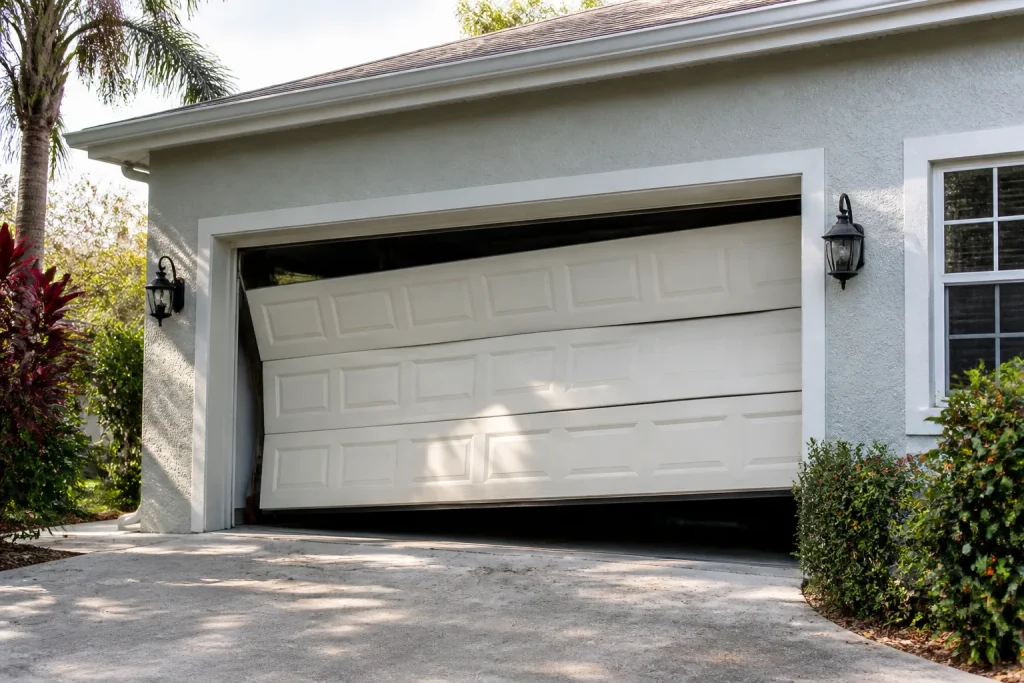
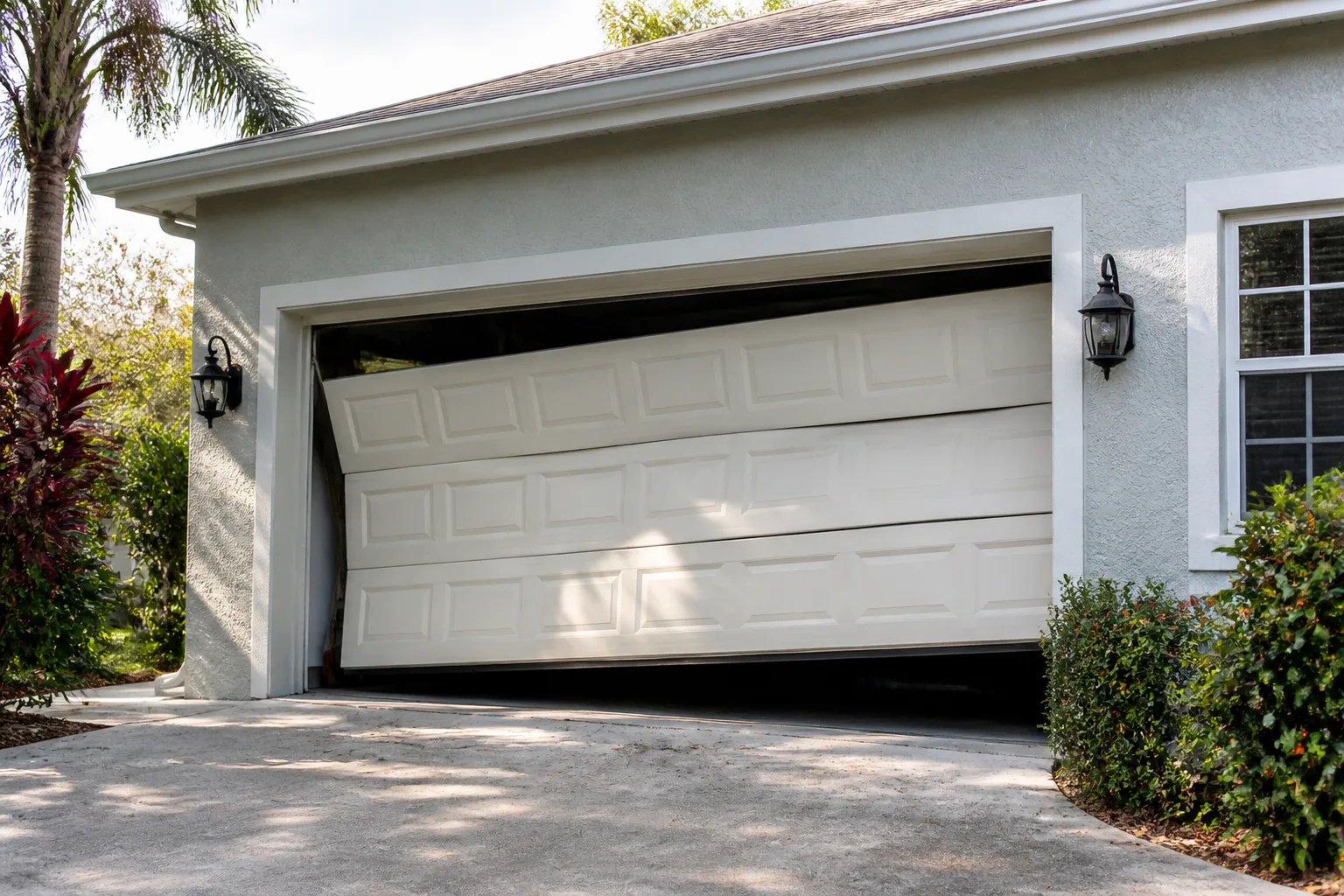
- A door that moves unevenly or tilts to one side – a stretched or unbalanced spring, or a cable that’s slipped.
- A loud bang from inside the garage – a torsion spring that has snapped. That’s not a warning anymore; the door is now unsafe to operate.
- The opener straining or the motor housing getting hot – the motor is fighting a door it isn’t meant to lift, usually because spring tension has dropped.
- A door that reverses or stops halfway – a misaligned safety sensor or a bent track.
- Visible gaps between the door and the frame – warped panels or a track that’s pulled loose from its mounting.
None of these fix themselves. A roller that grinds today is a roller that seizes in a few weeks, and once it seizes it starts chewing into the track. That’s when a cheap repair turns into a track and opener job. If you’re noticing any of these in your North Port home, it’s worth having it looked at before the list gets longer.
Why is slow response time the most underestimated warning sign?
A door that takes a moment longer to start moving is the warning sign homeowners most often explain away. It’s also the most telling one. That hesitation almost always points to one of two things: spring tension that’s slowly dropping, or an opener motor carrying more load than it was built for. Both get worse over time, and neither corrects itself.
Here’s what’s actually happening. The torsion springs on your door are what hold its weight. When they’re healthy, the opener does very little work – it mostly just guides the door up and down. As the springs relax, the opener has to lift more and more of that weight directly. On a door running a Genie or LiftMaster opener, that extra strain shows up first as sluggishness and heat, then as strain on the gears and the drive. Left alone long enough, the motor gives out trying to move a door it was never meant to lift on its own.
In our experience across North Port, this is the symptom people sit on the longest, because the door still works. It just works worse. We’d rather see a door at the hesitation stage than at the snapped-spring stage, because the repair is simpler and the written estimate is smaller.
What Florida heat and humidity do to a garage door that drier climates don’t
North Port’s humidity and heat put more stress on the moving parts of a garage door than a drier climate would. Steel cables fray faster. Lubricant dries out and the rollers and hinges start to seize. The heat cycling alone – warm days, cooler nights – works the springs and cables harder over the course of a year. The result is that components wear out on a shorter clock here than they might somewhere cooler and drier.
What to watch for specifically in North Port:
- Frayed or kinked cables. Look at the cables running down each side. Fraying strands or a kink are the clearest sign a cable is on its way out. A failing cable can let the door drop without warning, so treat it as urgent.
- Seized or gritty rollers. Rollers that no longer spin freely put extra strain on the track and the opener. If the door sounds rough as it rolls, the rollers are likely the cause.
- Rust or corrosion on the hinges and hardware. Humidity works quietly on the small parts first. Rusty hinges mean more friction, and more friction means more load on the motor.
- Sticking or skipping on the track. When the door catches at a certain point, the rollers or the track alignment are usually the reason.
A door with these problems is a candidate for garage door repair, and the sooner it’s checked, the more likely it’s a repair and not a replacement. If your door is slow, loud, or catching in North Port, that’s the moment to call, not next month.
How to run the balance test yourself (safely)
The balance test is the one check we’d encourage any homeowner to do, because it’s safe and it tells you whether your springs are losing tension. It’s also the quickest way to find out if your door is heading for a spring failure before you reach the point where it doesn’t open at all.
Here’s how to do it, in plain terms:
- Close the door fully and disconnect the opener using the release cord (the handle you pull to switch to manual).
- Lift the door by hand about halfway up, then let go and step back.
- A healthy door stays put or drifts slightly. A door that falls back down, or that takes real effort to lift by hand, has springs that have lost tension.
That’s the whole test. What you should not do is try to adjust the springs or the cables yourself. Torsion springs store an enormous amount of energy, and adjusting them without the right tools and training is genuinely dangerous. We say that as a point of care, not as a sales line – it’s the reason spring work is a job for a trained technician, and the reason we handle it in-house rather than passing it to a general handyman. If the balance test shows a problem, it’s time to call. A door that fails the test is a candidate for garage door spring repair, and the longer you leave it, the more likely the springs are to snap and take other parts with them.
How a bent track quietly wears out your opener
A bent track is the cascade failure most homeowners don’t connect until it’s too late. The track looks like a minor annoyance. The real damage is happening at the other end of the system, in the opener motor, which has to work harder every time the door hits the bend. A slightly off track means the rollers drag, the door binds, and the motor pushes through all of it. That load doesn’t announce itself. It just overheats the motor, wears the gears, and shortens its life.
Because of that, a bent track usually shows up as two problems instead of one. By the time the door finally stops moving, you’re often looking at track repair and garage door opener repair at the same time. That’s the cascade: a cheap alignment issue that becomes a motor replacement because the door kept running against a bend. If your door pulls to one side, rubs the frame, or you’ve hit the track with a car or a ladder, get it looked at. A door that runs true costs less to keep running. Running a Clopay or Amarr door against a bent track is a sure way to shorten the life of everything attached to it.
When to call a pro vs. what you can check yourself
Some of this is safe to check yourself: listening for grinding, watching for uneven movement, noting a slow start, looking at the cables and rollers for obvious wear, and running the balance test. That’s all observation. The moment it turns into adjustment or repair, it’s time for a trained technician.
Call a pro when you see:
- Any sign of a snapped or heavily slack spring
- A frayed or kinked cable (a door can drop without warning)
- A door that reverses, won’t close, or stops halfway
- A bent track or a door that’s pulled off its rollers
- An opener that’s straining, overheating, or unresponsive
- A door stuck open or closed when you need it secure now
That last one is where emergency service matters. A door stuck open on a North Port home is a security problem, and a door stuck closed traps a car. Emergency garage door service is a core part of what we do, not a side offering, and our technicians have up to 15 years of experience across mechanical systems and smart openers alike. We service LiftMaster, Chamberlain, Genie, Clopay, Amarr, Wayne Dalton, Craftsman, and Raynor systems, so whether you’re on a Wayne Dalton door with a legacy opener or a connected-home setup, it’s covered.
Related services in North Port: if you’re not sure which applies, start with North Port Garage Door Repair Pros and we’ll point you to the right one.
What do these repairs typically cost?
Costs vary depending on the part and the door, but here’s a rough guide so you know what to expect before anyone arrives:
- Roller and hinge service: the lower end of the repair range, since these are the small parts that wear first.
- Track realignment: a modest repair if caught before the opener is affected.
- Opener repair or replacement: a mid-range job, depending on the opener.
- Spring repair: priced per spring; a matched pair is usually replaced together, so a pair costs about double one spring.
Prices are estimates, and the written estimate you get before any work starts is what you’ll pay. There’s no surprise invoice waiting on the back end. The point of catching problems early is that you stay in the cheaper tiers – the grinding roller is a roller job, but the seized roller that wore out the track and strained the motor is not.
The Bottom Line
The signs worth taking seriously are the quiet ones: a slight grind, a door that hesitates, a tilt to one side, a cable that’s looking frayed. They’re the early-stage signals of failures that get bigger and more expensive the longer they’re ignored. Cosmetic wear can wait. Mechanical warning signs can’t, especially in North Port’s heat and humidity, which age the moving parts faster than you’d expect.
Catch the small fix while it’s small. If you’re in North Port and need help, North Port Garage Door Repair Pros offers free estimates – call (855) 610-6385. We’ll diagnose what’s actually wrong, quote it before any work starts, and tell you honestly whether it’s a repair or time for something new.
Frequently Asked Questions
The first sign is usually a change in sound or movement – a slight grind, a door that moves unevenly, or a short pause before it starts. These point to worn rollers, dropping spring tension, or an opener carrying too much load. Any of them is worth a look before it gets worse. Call (855) 610-6385 for a free estimate.
No. Torsion springs store a large amount of energy, and adjusting or replacing them without the right tools and training is dangerous. Safe homeowner checks are limited to observing and running the balance test. Spring repair should always be done by a trained technician. Call us for a free estimate.
Lift the door by hand with the opener disconnected, halfway up, and let go. If it falls back down or takes real effort to lift, the springs have lost tension. A loud bang from the garage, or a door that won’t open, means a spring has already snapped. Call (855) 610-6385 to have it checked.
Yes. A bent track makes the door drag, and the opener motor has to push through that drag every time the door runs. Over time that extra load overheats the motor and wears the gears, so a track issue can turn into an opener replacement. Get a bent track looked at early. Call us for a free estimate.
Written by the team at North Port Garage Door Repair Pros.
Need Garage Door Help?
Call North Port Garage Door Repair Pros - the local pro we connect you with is licensed and insured, here with fast after-hours help in North Port.
(855) 610-6385